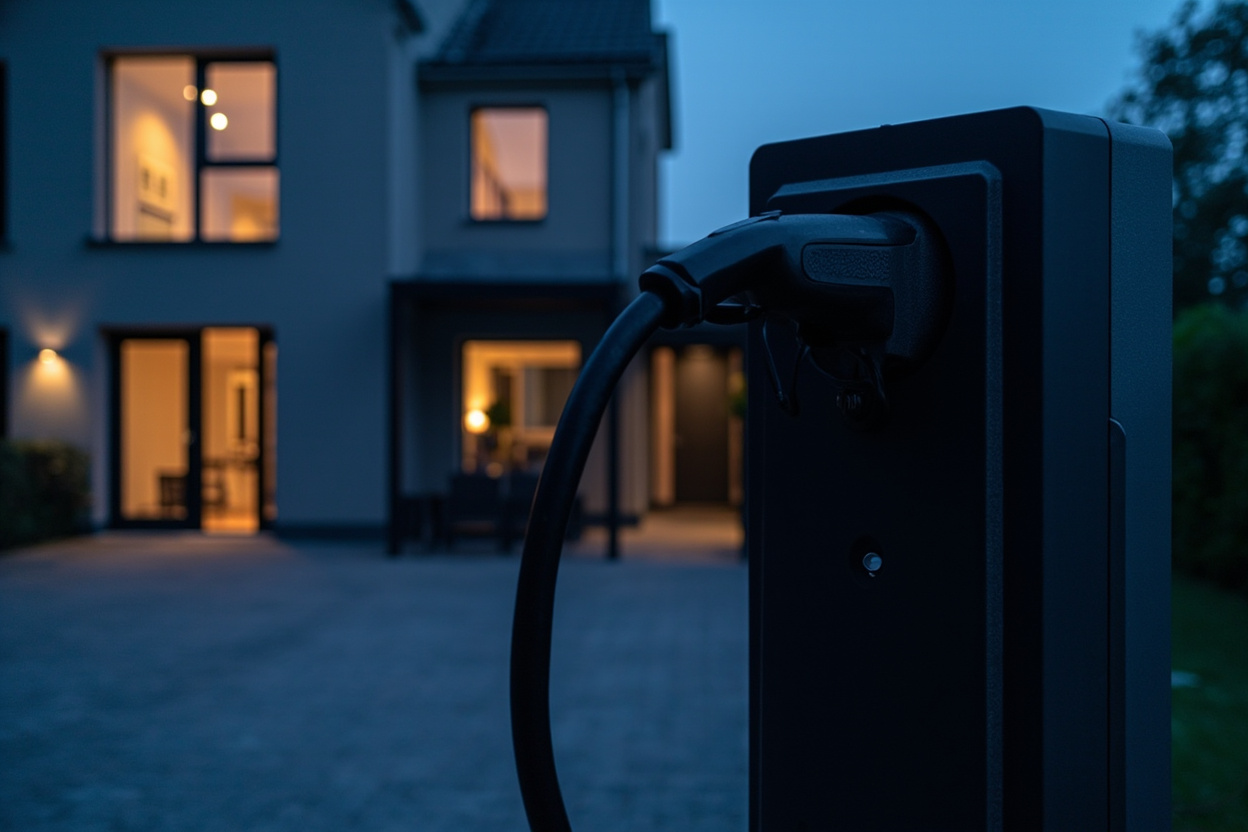
Charging at home
EV charger in Hoofddorp
- for a charge point in the street
- the municipality
- enough for a car parked 14 hours
- 3.7 kW
- where solar charging starts
- 1.4 kW
Which office handles which request, and why home charging is a question about capacity
Two different things are both called a charge point in the Netherlands, and only one of them is something you buy. This page starts there, because most of what people search for concerns the other one.
Two requests, two counters
1 of 4
If your car is parked on the street, you apply to the municipality of Haarlemmermeer for a public charge point. It costs you nothing, you do not choose the brand, the post stays the property of the operator, and the municipality designates the location, usually with a traffic order attached. That is not a service anyone sells you, and it is better to read that here than to discover it after a sales visit.
If you have a driveway, garage or carport, it is a charge point on your own installation. That is electrical work in your consumer unit, and it is the only one of the two an installer is involved in. Everything below concerns that second case.
Capacity is a question about parked hours
2 of 4
The commonest mistake at home is buying too much power. A car that arrives at six in the evening and leaves at eight the next morning stands still for fourteen hours. At 3.7 kilowatts that adds more than fifty kilowatt-hours, which for most cars is more than a full week of commuting. An 11 kilowatt charger puts the same fifty in over five hours, but the car is still sitting there for the other nine. Power you never use overnight earns nothing and does take space in your consumer unit.
That space is the real subject. A single-phase 35 amp connection gives the whole house about eight kilowatts; a three-phase 25 amp connection about seventeen. An 11 kilowatt charger draws sixteen amps per phase. Put an induction hob, a water heater and eventually a heat pump beside it and the main fuse, not the car, is the bottleneck. Load balancing measures what the rest of the house is using and throttles the charger back. It is not an accessory: it is the component that stops a home charger from turning into an upgrade of your connection.
That weighs more here than elsewhere. In Haarlemmermeer the network pressure is on the consumption side, and Liander has published congestion research for this area on exactly that side. A heavier connection is therefore not a form to fill in but a waiting time, and the higher standing charge continues for as long as the connection exists.
Charging on your own generation, and why the car is elsewhere
3 of 4
After 1 January 2027 a self-consumed kilowatt-hour is worth substantially more than an exported one, and an electric car is in principle the largest consumer in the house: 2,000 to 3,000 kilowatt-hours a year, more than a home battery ever cycles. In principle, because your roof's surplus arrives between eleven and three and the car is in a car park at work.
Three things decide whether that principle is worth anything. Whether anyone is home during the day. Whether you can charge at weekends, which for many households is the only time surplus and car coincide. And whether the charger can follow a surplus at all: one that only knows full power can do nothing with two kilowatts. A charger that throttles down to about 1.4 kilowatts, which is six amps on one phase, can run on sunshine alone. That is one line in a datasheet, and it is the difference between a car that absorbs your surplus and a car that adds to your evening peak.
What happens in the consumer unit
4 of 4
A charge point belongs on its own circuit, with residual current protection suitable for the DC leakage a car can produce. Some chargers include that protection, others require it in the consumer unit; the difference shows up in the price and it is precisely the item a cheap installation leaves out. Then the cable run to the consumer unit, the conductor size that goes with its length, and how the cable follows the facade.
Running a cable across public ground is governed by municipal policy. A loose cable over the pavement is allowed almost nowhere; some municipalities permit a recessed cable channel in the paving and others do not. That is a question for the municipality of Haarlemmermeer rather than for your installer, and the answer decides whether a charger on your facade is usable at all when the car is parked on the street.
What is left of your connection
1 x 35 A
about 8 kilowatts for the whole house
3 x 25 A
about 17 kilowatts
- 11 kilowatt charger
- what is left for the rest of the house
- the main fuse
Three things most quotes get wrong
A post in the street is not yours
With a public charge point the municipality designates the spot, the operator chooses the equipment, and the post remains the operator’s property. You cannot reserve it and you do not set the tariff. What you can do is submit the request, which costs nothing and runs on the municipality’s timetable.
Load balancing is not an accessory
Without it, the charger is the last load added and the first thing to trip the main fuse. With it, the system reads household consumption and throttles the charger back when the hob comes on. It is the cheapest way to avoid upgrading your connection altogether.
Six amps is the floor of solar charging
A car will not charge below roughly 1.4 kilowatts, because six amps on one phase is the lowest current the charging protocol allows. Below that surplus, the session simply stops. This is why a charger able to fall back to single-phase is more useful for solar charging than one that only works three-phase.
From consumer unit to charging profile
Look at the consumer unit
Connection rating, main fuse, free space on the rail and the existing residual current protection. That determines whether load balancing is needed and what power will fit at all.
half an hour
Choose power on parked hours
We calculate on the hours the car genuinely stands still and on what your car accepts at home, not on what the charger can deliver. That is often less than expected, which saves both money and space.
with the proposal
Install with load balancing
A dedicated circuit, the correct residual current protection, the cable run neatly along the facade, and a measurement that includes household consumption so the charger throttles back when the hob comes on.
usually half a day
Set the charging profile
Surplus charging enabled where your roof and your routine allow it, with the threshold at which the charger still starts. Then a week of checking that it really runs on sunshine and not on the grid.
after one week
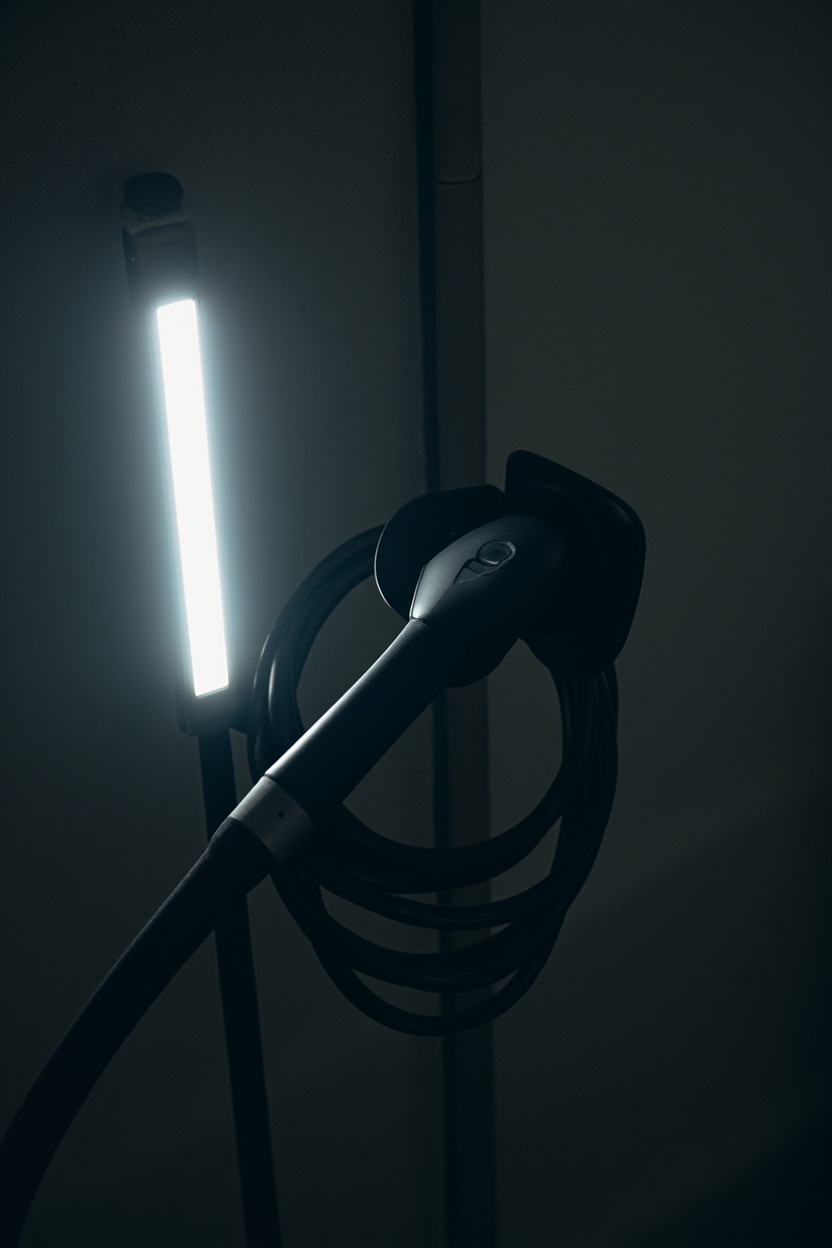
The cost splits into the unit and the work. A simple wall charger of 3.7 to 7.4 kilowatts usually costs between 700 and 1,200 euros; a three-phase 11 kilowatt unit with load balancing and its own metering runs from 1,200 to 1,900. Installation is on top: a dedicated circuit, the residual current protection, the cable run to the consumer unit and the fixing work. With a short run that stays around 400 euros; through a crawl space or across fifteen metres of garden it climbs.
Single-phase or three-phase is not a status question. Three phases help if you cover high daily mileage or if your car can actually charge on three phases, and many models charge on one phase at home regardless, in which case a three-phase charger adds nothing. Read your car's datasheet before you read the charger's.
There is no national subsidy for a charger at your own home. What does exist is the ability to account for business kilometres if you charge a company car at home, which requires a charger with its own metering. That is the main reason the more expensive variant exists, so establish whether you need that reconciliation before choosing: it moves the price by a few hundred euros in either direction.
Renting rather than buying is more common here than with panels. A rental arrangement through a leasing company is administratively simple, but over a five-year term you usually pay more than the unit costs, and the contract follows you when you move. Buying is cheaper once you expect to stay longer than about three years.
If you are pairing a charger with solar panels, the figures to look for are the lowest current the charger supports and whether it can drop from three phases to one. Together those decide whether it does anything with a two kilowatt surplus. Without them you will in practice be charging in the evening on imported power, which after 2027 is the most expensive kilowatt-hour there is.
In Hoofddorp, Nieuw-Vennep, Badhoevedorp and the other villages of Haarlemmermeer a large share of the housing stock has its own driveway, which is why home charging is more often a realistic option here than in an older city district. Where it is not, the municipal request is the route, and that is set out separately.
Ranges, not promises. What your roof does follows from the survey, not from this figure.
Questions about ev charger in hoofddorp
Do I apply to you or to the municipality?
To the municipality if the car is parked on the street: a public charge point is requested from the municipality of Haarlemmermeer, costs you nothing, and stays the property of the operator. To an installer if you have a driveway, garage or carport. Only the second is work on your own installation.
Do I need three phases?
Usually not. Many cars charge on a single phase at home anyway, and a car standing still for fourteen hours has taken on more than fifty kilowatt-hours at 3.7 kilowatts. Three phases make sense for high daily mileage or for a car that genuinely charges three-phase. Check the car’s datasheet first.
Can I charge on my own solar output?
Only if the charger can throttle down to about 1.4 kilowatts, which is six amps on one phase; below that a session will not start. A charger that can fall back from three phases to one keeps going on a small surplus. Without that, you will be charging in the evening on imported power.
Will my connection have to be upgraded?
Often not, provided load balancing is fitted. It measures what the rest of the house is drawing and throttles the charger back. Without it, an 11 kilowatt charger next to an induction hob is a main fuse waiting to trip. A genuine upgrade means a waiting time in this area and a higher standing charge afterwards.
What does a home charger cost?
The unit itself is 700 to 1,900 euros depending on power, load balancing and whether it includes metering for business mileage. Installation is on top and depends on the cable run to the consumer unit: around 400 euros for a short route, more through a crawl space or across a long garden.
May I run a cable across the pavement?
Loose across the pavement, almost nowhere: it is a trip hazard and municipalities do not permit it. Whether a recessed cable channel in the paving is allowed is municipal policy and differs from place to place. Ask the municipality of Haarlemmermeer, because the answer decides whether a charger on your facade is usable when the car is on the street.